1. Home
  2. Our Process
  3. Our Equipment

Concrete Grinding Equipment & Specs

Most epoxy floors that peel, bubble or yellow failed because of shortcuts in prep, not the product. Here is the equipment and know-how that keeps yours from being one of them, and what to ask any contractor before you hire.

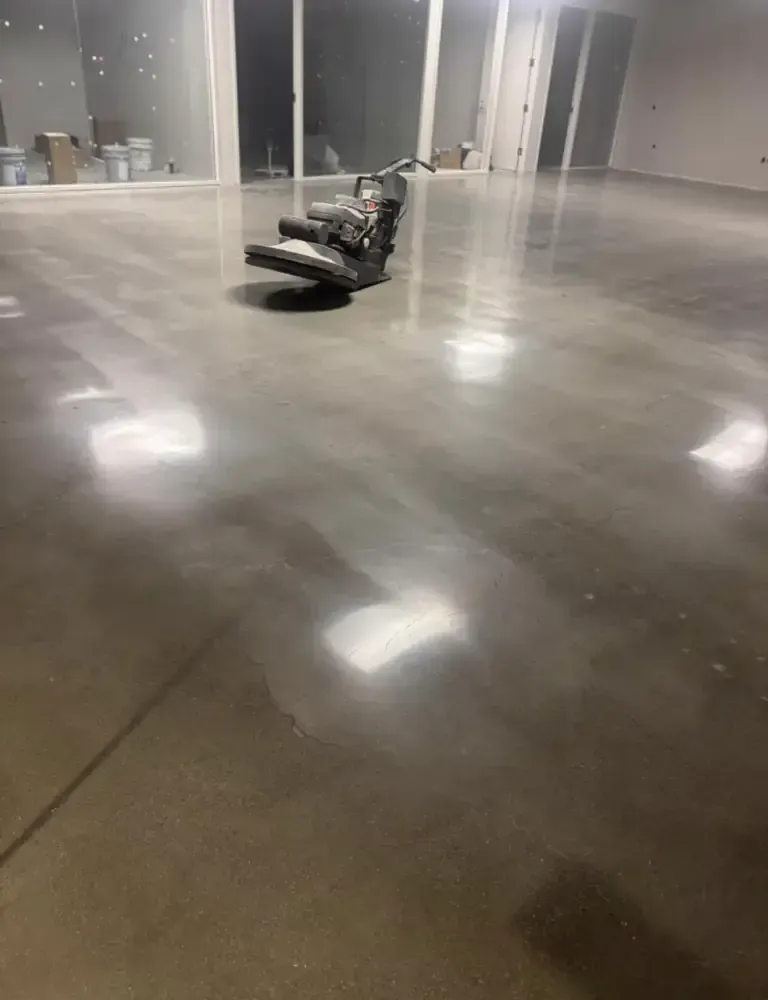
Polishing grinder on a concrete slab

Why the contractor matters

Same product, very different floor.

Two crews can put the same epoxy on the same garage. One floor lasts for years; the other peels in a season. The difference is everything that happens before the coating goes down.

What goes into the floor The shortcut How we do it
Surface prep Acid etch or just a wash, so the coating sits on top of the slab Diamond-ground to about CSP 2–3 so the coating bonds into the concrete See the gear
Old paint and sealer Coated right over, and the new floor lifts with the old layer Ground off with coarse metal bonds or PCDs down to bare concrete See the gear
Edges and corners Left smooth where the big machine cannot reach, so peeling starts at the walls Hand-ground with shrouded edge grinders, wall to wall See the gear
Moisture Never tested, until the floor bubbles Tested before we quote, per ASTM F2170 or F1869 See the gear
Dust Swept up with a broom; silica dust ends up in your house Captured at the grinding head by a HEPA H13 extractor See the gear
Top coat A thin coat that yellows in sunlight UV-stable polyaspartic on every garage floor See the gear

How floors fail, and how we stop it.

Almost every failed floor we are called to fix shows one of these. Each one traces back to prep.

  • Peeling at the edges

    The coating was never bonded where the big grinder could not reach.

    We hand-grind every edge, corner, stair nose and drain.

  • Bubbles and lifting

    Moisture pushing up through the slab breaks the bond from below.

    We moisture-test first and tell you before any coating goes down.

  • Flaking under hot tires

    A thin coat over a slab that was only cleaned or etched.

    Diamond grinding plus a full base coat and top coat.

  • Delamination

    New epoxy laid over old paint, sealer or a failing DIY kit.

    Old coatings come off with PCDs before anything new goes on.

  • Yellowing

    No UV-resistant top coat, so sunlight and even indoor lighting turn it amber.

    Polyaspartic on every garage, a UV-resistant top coat everywhere else.

The equipment behind it

The machines, with the numbers.

What actually shows up at your job, and what each piece is for.

Machine 01 · surface prep

The planetary floor grinder

This is the guy you see on the home page. Three diamond heads spin one way while the whole deck turns the other, so the slab gets cut evenly instead of in swirls. It is how a garage goes from smooth and sealed to open and ready to bond.

Class Husqvarna PG 530-class planetary grinder
Grinding width 21 in (530 mm)
Weight About 460 lb (210 kg) complete
Heads Three diamond heads on a planetary drive, turning against the main disc
Power Single-phase or three-phase versions
Job Opens the slab to a coating profile, removes old coatings, flattens high spots

Machine 02 · dust control

The HEPA dust extractor

Every grinder runs hooked to this. Concrete dust carries crystalline silica, so we capture it at the head instead of sweeping it up later. Your house stays clean, and so do our lungs.

Class Husqvarna S 26-class dust extractor
Filters Two individually tested HEPA H13 filters
Capture 99.99% at 0.3 microns, the respirable silica range
Airflow About 235 to 258 cfm, depending on version
Weight About 103 lb (47 kg)
Cleaning Jet Pulse pre-filter cleaning mid-job

Tooling · the part that does the cutting

The diamonds

The grinder is just the muscle. The diamonds decide the finish. A coating wants a rough, open surface; a polished floor wants the opposite, so the grit steps all the way up until the concrete reflects the lights.

Coating prep Metal-bond diamonds, roughly 16/30 to 30/40 grit, for a profile coatings grip
Flattening Coarser metal bonds or PCDs to lift old coatings, mastic and glue
Polishing Resin-bond pads stepped about 50 → 100 → 200 → 400 → 800 → 1500 → 3000
Bond choice Harder concrete gets a softer bond, softer concrete a harder one
Changes Swapped for every step, never skipped

Machine 03 · the last inch

Edge and hand grinders

Most failed garage floors peel from the edges first. These get into the corners the big machine cannot, so the coating bonds wall to wall.

Tool 7-inch hand grinders with dust shrouds
Dust Shroud tied into a HEPA vacuum
Job Walls, corners, stair noses, around drains and posts
Why The big grinder cannot reach the last couple of inches

Before anything gets coated

Moisture testing

Chicago basements and new slabs can hold a lot of water. We test before we quote the system, not after it bubbles.

In-slab test Relative humidity probes per ASTM F2170
Surface test Calcium chloride test per ASTM F1869 when it fits
New concrete Usually about 28 days of cure, then a passing test
Why Moisture pushing up is a top cause of coatings lifting

What the crew wears

Respirators and PPE

The mask on the home page is not a costume. Grinding concrete is dusty work, and doing it right means protecting the people in the room, including you.

Respiratory Half-face respirators with P100 filters while grinding
Rule we follow OSHA respirable crystalline silica standard, 29 CFR 1926.1153
Also Eye and hearing protection, knee pads, spiked shoes on wet coatings

Machine 04 · the part you see

The coating gear

Once the slab is open and clean, it is all about timing: mix, spread, broadcast, scrape, top coat, each layer laid while the one below is ready for it.

Mixing Paddle mixers, timed batches so nothing flashes in the bucket
Spreading Notched squeegees and 3/8-inch rollers
Walking on it Spiked shoes so we can broadcast flake into wet coating
Top coat UV-stable polyaspartic on every garage floor

Figures are the manufacturers’ published numbers for each machine class. The exact rig on your job depends on the slab and the room. Ask us what is coming to yours: (224) 321-2395.

Before you hire anyone

Six questions to ask any flooring contractor.

Ask every company you get a quote from, including us. Here are our answers.

  • Do you diamond-grind, or acid etch? We grind. Etching cannot open the slab evenly or remove old sealers.
  • Do you test for moisture, and how? Yes, with in-slab RH probes (ASTM F2170) or a calcium chloride test (F1869), before we quote.
  • How do you handle the edges? Shrouded hand grinders on a HEPA vacuum, into every corner the big machine cannot reach.
  • What do you do about dust? Every grinder runs on a HEPA H13 extractor, and the crew wears P100 respirators per the OSHA silica standard.
  • What top coat goes on my floor? UV-stable polyaspartic on every garage floor; we match the top coat to the room everywhere else.
  • Are you licensed and insured? Yes. Fine Services LLC is a licensed and insured Chicago contractor, and the crew that quotes your floor installs it.

Questions

Equipment questions.

Still deciding? Call or text (224) 321-2395 and talk to the people who will actually do the work.

Is concrete grinding dusty?

Not the way we do it. Every grinder runs connected to a HEPA dust extractor that captures dust at the grinding head, and edges are ground with shrouded hand tools on a HEPA vacuum.

Why grind instead of acid etching?

Diamond grinding opens the concrete to a consistent profile and removes weak surface material and old sealers, so the coating bonds mechanically. Etching cannot do that evenly.

Do you test for moisture?

Yes. We test before recommending a system, using in-slab relative humidity probes or a calcium chloride test, because moisture coming up through a slab is a leading cause of coatings lifting.

Why does it matter who installs my epoxy floor?

Because most floor failures are prep failures. The same product lasts for years or peels in a season depending on whether the slab was diamond-ground, the edges were hand-ground, moisture was tested and old coatings were removed first. That work takes the right equipment and a crew that knows what to look for.

What should I ask a flooring contractor before hiring?

Ask whether they diamond-grind or acid etch, whether and how they test for moisture, how they handle edges and corners, what they do about silica dust, what top coat they use, and whether they are licensed and insured. A good contractor answers all six without hesitating.